What is a vision statement?

By Sheperd Simmons On Strategic Planning
A vision statement is… not this
Please for the love of all that’s strategic, do not go by Wikipedia’s definition of a vision statement. It’s sooo bad. I had no choice but to correct the record. (In fairness, let’s remember that Wikipedia is “the free encyclopedia.” You get what you pay for.)
My mission to define vision and mission was rudely interrupted
I set out to write this post on “vision vs. mission.” Like a good little writer, I started by putting myself in the mind of my target audience. Which could be one of three people:
- Someone who’s wondering if they really need a company vision.
- Someone who knows they need one, and wants to know how to write a good vision statement.
- Someone who already has a stated business vision, but they suspect it sucks. And they want to fix it.
Do any of these describe you? If so, I figured that you might start the vision-writing process by first looking up the definition of vision. You know, to get yourself pointed in the right direction.
I’m about to get mean about the meaning of vision statement
Forgive me, but this is a wrong that I must right. When I Googled “what is a vision statement,” what I found was so disgusting that I simply had to stop (SFX: needle dragging across record) and devote an entire article to dealing with this travesty. Good Lord, this world needs help.
Specifically, it was Google’s featured snippet that caught my eye — and offended my brain: a vision-statement definition from Wikipedia. Which is really not helpful, unless it’s one of those days where you could really use a good laugh:
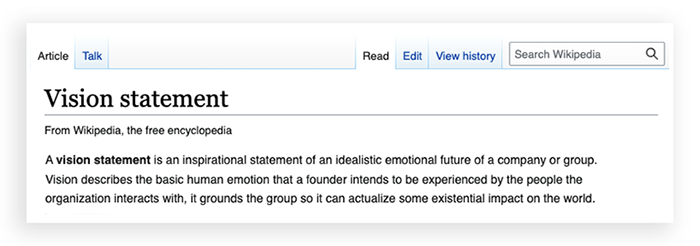 Credit: Wikipedia.org
So this is what Google deems authoritative? Ugh. Well, at least they got the “inspirational” part right. Otherwise this is some first-class BS. How can a group be “grounded” by an “existential impact on the world”? Are you telling me that James back in engine repair is going to get giddy about actualizing his existential impact?
And a vision doesn’t “describe an emotion.” Imagine:
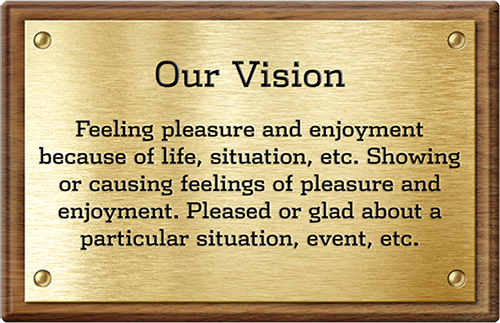 Credit: merriam-webster.com
Let’s walk through this dastardly vision definition, step by painful step
Click on through, won’t you? To the full Wikipedia entry. Under “General Philosophy,” it posits the following.
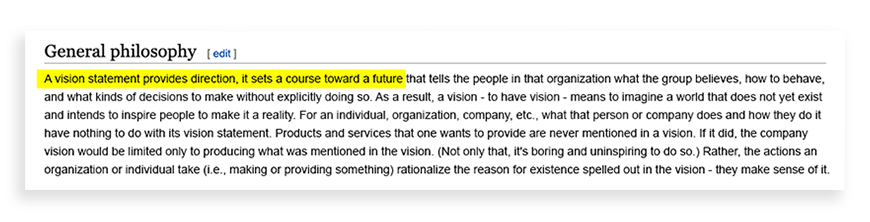 Okay Wiki contributor. We’ll try to look past that run-on sentence there, you expert you. But we’re off to a solid start. It’s a setup, I tell ya, a setup!
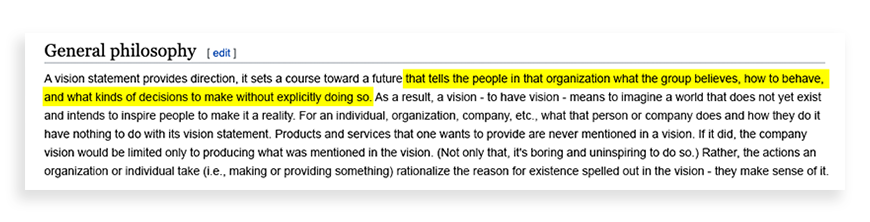 Here we go. Aww HAY-yull naw. You can’t put all that crap in a vision statement. That’s exactly how visions get bloated. I’d say that’s also how they get forgotten, except this presupposes they were remembered in the first place. Won’t happen, pal. If you follow this direction, dear reader, you’ll need another vision… a world where people might actually remember (much less be inspired by) your overly ambitious opus. Clearly we need some message strategy here.
(I recently was exposed to the worst vision statement I’d ever seen. It was 97 words long. Three paragraphs. I literally LOLed when I read it. But hey, a little understanding here. You need plenty of room if you’re going to squeeze in every buzzword you can think of.)
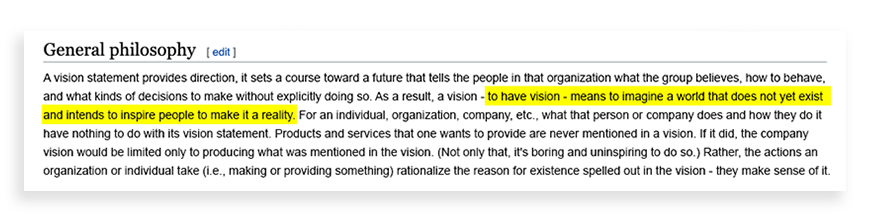 Mostly agree here. Although this world could already exist. (Notice that Wikipedia and I both talk in terms of making a vision a reality. That means you attain it!)
Hey, here’s a vision statement: Never say never
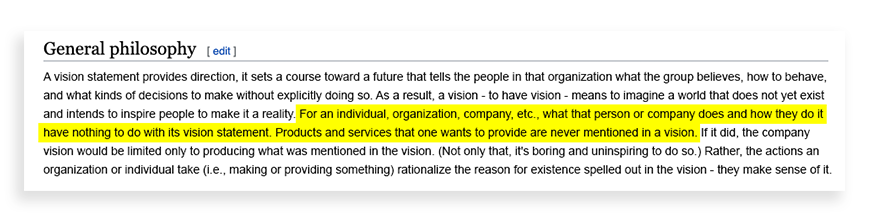 Okay, so we’re saying here that your vision should be entirely irrelevant to what you actually do. Are you getting this?
So we’re saying here that your vision should be entirely irrelevant to what you actually do. Are you getting this?
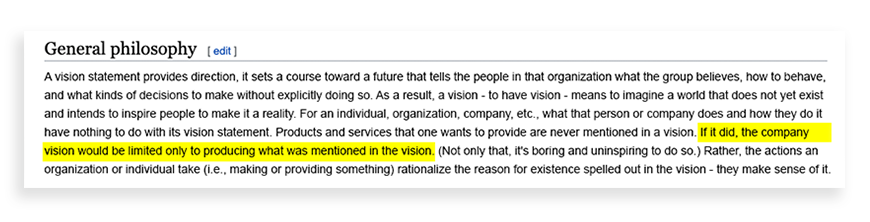 This assumes that the company vision can never change (I’ll deal with that notion in a minute). And it assumes that you will explicitly mention specific products and services, as opposed to something a bit broader, such as a product category or a market segment. Two big assumptions. Remember what happens when you assume?
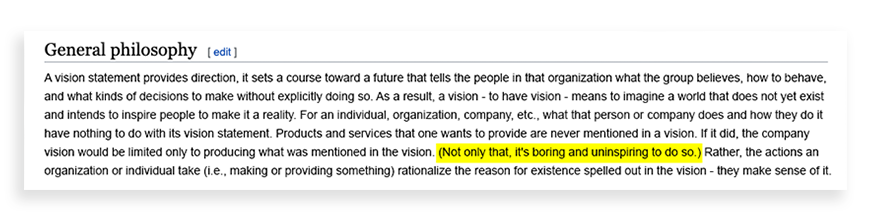 Feel the tone of the author here? A bit immature. And don’t get me started on this topic. I’ll just say that most products and services are made to fill a need or solve a problem that is important to somebody. What right does this author have to dictate that what is important to somebody else is in fact not important, not exciting, and not inspiring? Dang, that’s really judgey.
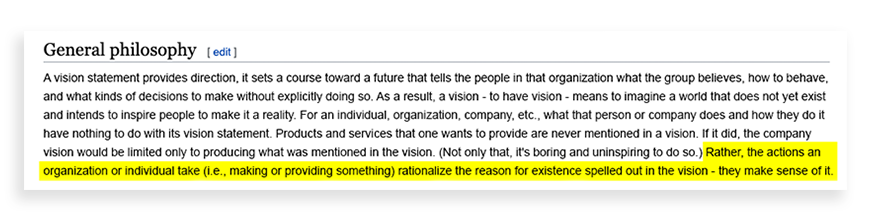 Also, we see here that the author doesn’t know the difference between a hyphen and an em dash. Maybe they’ll give us some advice on punctuation next!
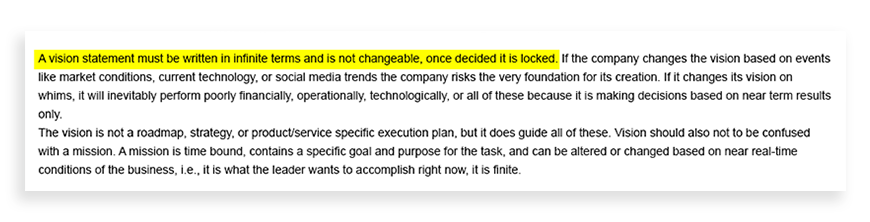 Let’s just ignore the grammar from now on, hmm? I admire the purity here. But it’s just flat not realistic to say that a vision is infinite and not changeable. The world changes in unexpected ways, as does our role in it. Especially in certain dynamic industries. So, never say never. But do strive to make your vision relatively timeless or semi-permanent. As best you can, anyhow… based on a future you can see today.
It’s just flat not realistic to say that a vision is infinite and not changeable.
Taking the long view is part of what makes a good vision statement good
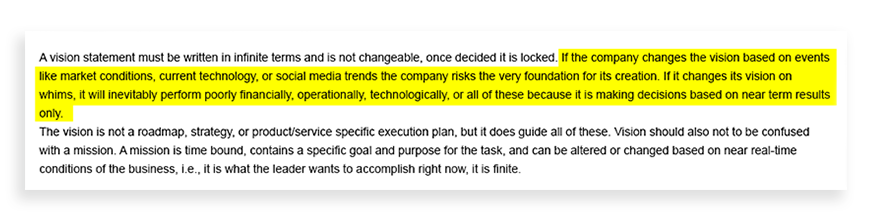 Credit the author here. Correct: Your vision should not change on a whim. You can’t say “Oregon or bust” today and “Florida or bust!” tomorrow. If you do, your team is going to quickly lose confidence in your leadership.
Okay, I confess… this vision statement definition isn’t all bad
Here’s a good thought:
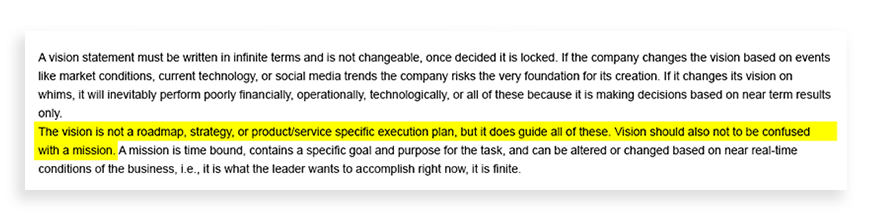 True, true, true, true, true. (I’m leaving out the author’s definition of a mission. That’s for another post.)
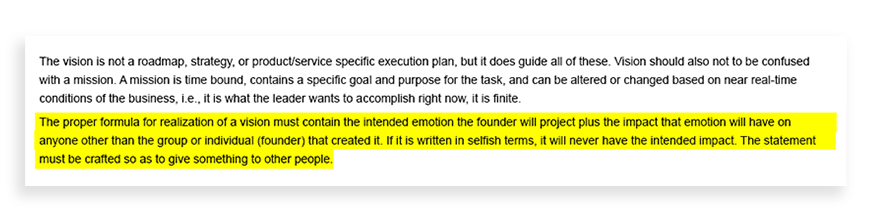 Goodness gracious. Comment withheld.
This Wikipedia entry goes on to discuss characteristics of a “good” vision statement, its purpose, and its relevance. Salute to the authors… good stuff here. Check it out.
Writing a vision statement, though…
Defining a vision statement is one thing. But creating a vision statement is a whole ’nother ballgame. So we hear in the Challenges section:
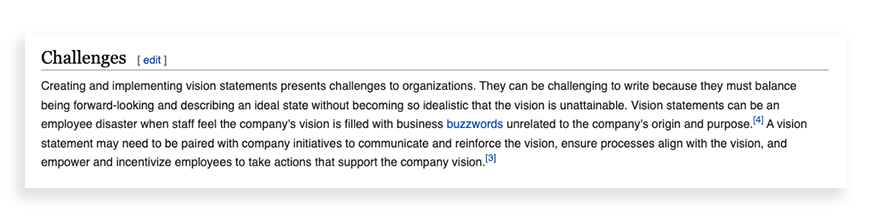 This is all good! I’m glad to be able to end this post on a happy note.
Of course if you’re feeling this challenge, maybe don’t do it alone? I humbly suggest you get yourself a counterpart for that. Developing a vision statement should be integrated into your overall strategic plan, and our Single Slide Strategy™ framework is just the ticket for that. I mean, don’t you want to become one of our case studies? That means success!
Boy, it sure is fun to write a post when you’re tearing down somebody else’s ideas. To be fair, though, Wikipedia entries evolve, and I hope this one will do so. Speaking of, good editing practice demands that I cite the date sourced. It was November 2, 2021. Which just so happened to be All Soul’s Day. Let’s pray for the misguided souls who wrote this piece, and even more so for the poor souls that followed it.
